When Robots Learn to Climb Stairs
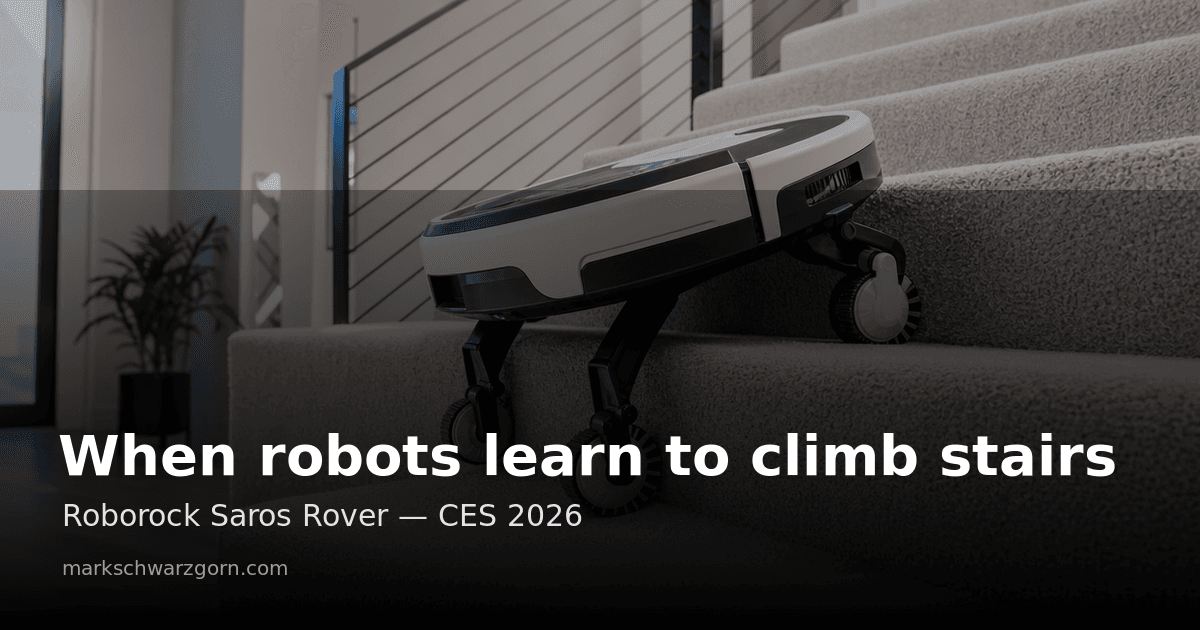
For a decade, one thing defied every robot vacuum on the market: the staircase.
Every other obstacle fell — thresholds, carpets, cables, even pets. But stairs remained the line robots couldn't cross. At CES 2026, Roborock crossed it.
The World's First Stair-Climbing Robot Vacuum
The Saros Rover is the world's first robot vacuum built on an AI-powered wheel-leg architecture. It doesn't just climb stairs — it cleans each step as it goes, lifting and lowering each leg independently, holding its body level while the ground shifts beneath it. Curved staircases, carpeted steps, slopes, multi-level thresholds: the "no-go zone" that defined an entire category is starting to disappear.
The Discipline Behind the Spectacle
What I find most telling isn't the spectacle of a vacuum climbing stairs. It's the discipline behind it. The same launch brought the Saros 20 and Saros 20 Sonic — 35,000 Pa of suction, a sonic mop scrubbing 4,000 times a minute, a chassis that learns and remembers how to cross obstacles it has seen before. One hand reaches for the moonshot; the other keeps shipping flagships that win on the living-room floor today. That balance is exactly what separates a gadget company from a robotics company.
Why We Distribute Roborock
This is why we distribute Roborock across Austria, Germany and the Benelux. The category is moving from "cleaning device" to "household robot," and the brands that treat mobility, autonomy and real intelligence as one system are the ones that will own the next decade of the connected home.
The staircase held out for ten years. It won't hold out much longer — and the home robot is quietly becoming one of the most ambitious robotics platforms in any house.
