Four Ways of Seeing the Garden
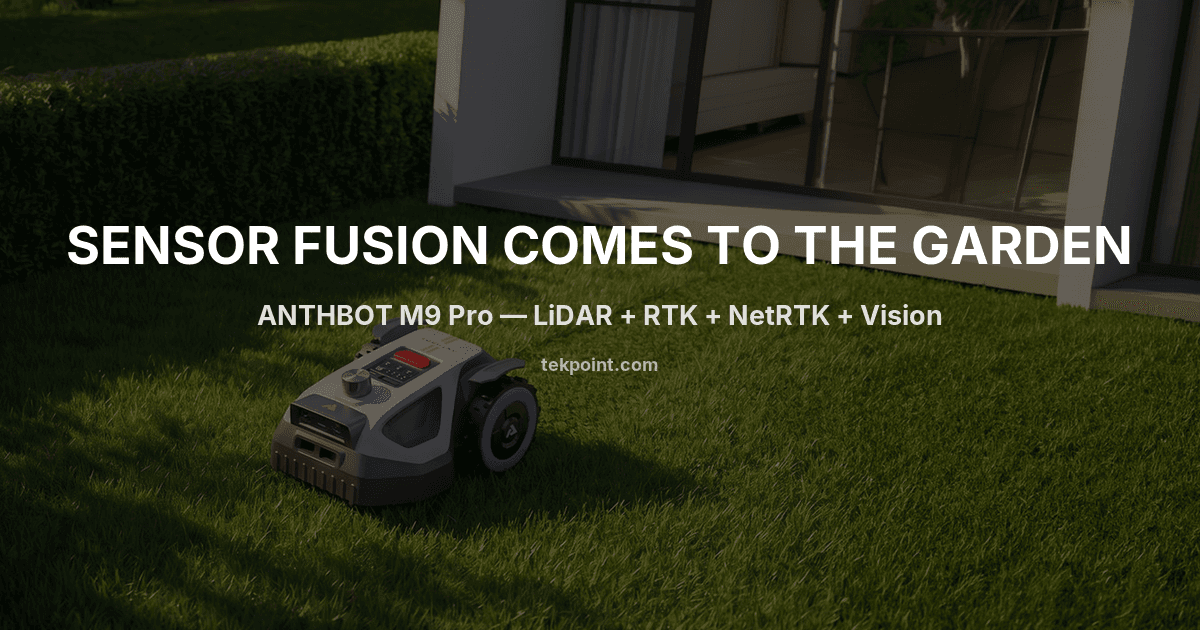
Every robot mower on the market makes a bet on one way of seeing the garden. And every one of those bets has a blind spot.
Boundary wire is the old answer: reliable, understood, and completely inflexible. Dig a new bed, move a path, plant a tree, and the wire resents you for it. RTK positioning removed the wire and replaced it with a dependency on a clean view of the sky — which gets shaky under dense trees or beside a tall house. Camera-first systems read the garden the way we do, which is wonderful until the sun sits low and washes the picture out.
None of these approaches is wrong. They just each have a condition under which they quietly stop being trustworthy. And "quietly" is the problem, because a mower you have to supervise isn't really saving you anything.
Don't Pick One
ANTHBOT's answer went on sale across Europe on 27 July, after a pre-order window that ran from 15 to 26 July: don't pick one.
The M9 Pro fuses four inputs — 360° LiDAR, RTK, NetRTK delivered over 4G, and dual HDR AI vision — into what ANTHBOT calls HoloSense Quad-Fusion. There's no boundary wire, and where 4G NetRTK reaches, there's no physical base station to mount on a wall or a pole either. That second part matters more than it sounds: the base station is the piece of a wire-free mower that still makes the installation feel like an installation.
The rest of the sheet is straightforward. It's rated for lawns up to 1,000 m², works at around 150 m² per hour, and handles slopes up to 45% — about 24 degrees. In Europe it lands at €1,299 official price. A smaller M5 Pro sits below it at €999, with pre-order units shipping from 15 August.
The Autonomous Vehicle Lesson
Sensor fusion isn't a marketing idea. It's how autonomous vehicles got to the point where anyone was willing to trust them.
Radar alone struggles with stationary objects. Cameras alone struggle with glare and darkness. LiDAR alone struggles with reflective and transparent surfaces. Put them together and each sensor's failure mode is covered by another sensor's strength. Nobody solved perception by finding the one perfect sensor; they solved it by making degradation graceful.
A garden is a much smaller problem than a motorway, but it's the same shape of problem. When one input degrades — trees over the RTK, low sun over the cameras, a shifted flowerbed the map doesn't know about — the others carry it. That's the difference between a machine that demos well and a machine you stop thinking about.
The Detail That Isn't on the Spec Sheet
The thing I keep coming back to, though, has nothing to do with sensors.
ANTHBOT has set up a logistics and service hub in Neuss, Germany. For a Shenzhen-based company selling four-figure machines into European gardens, that is the unglamorous investment that decides whether a buyer ever becomes a repeat customer. A mower is not a phone case. It lives outdoors, it takes weather and impacts, and at some point it needs a part. If that part means a return shipment to Asia and a six-week wait, the technology stops mattering.
We've distributed ANTHBOT since the early days, and this is the move I'd have argued for. Hardware credibility gets you onto the shelf in Europe. Infrastructure keeps you there.
Spec sheets win the first sale. Service networks win the second.
